Technical SEO Checklist: 8 Things We Audit for Every New Client
Alex••4 min read
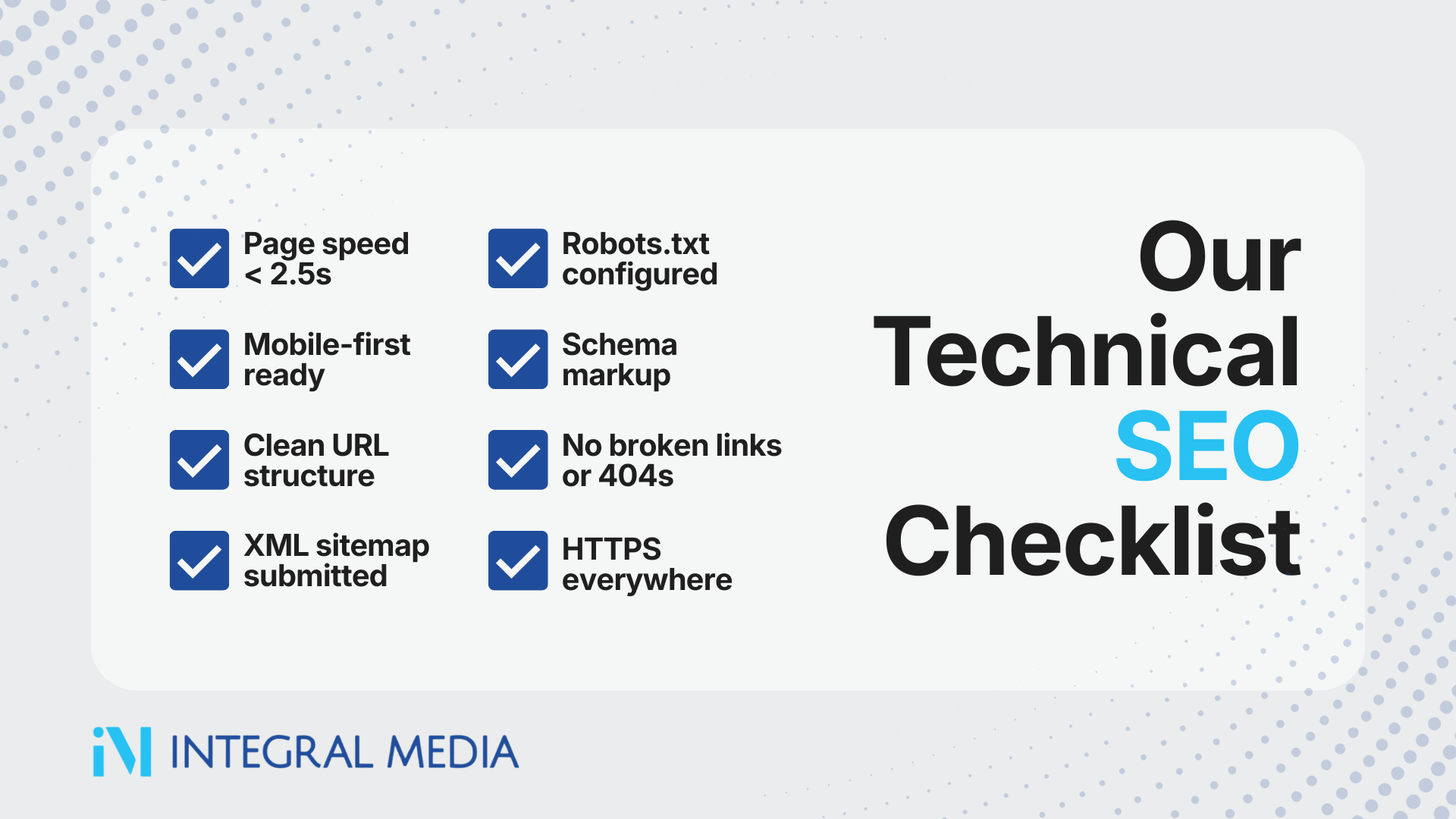
Most businesses invest in content, social media, and paid ads, then wonder why their website still is not ranking. The culprit is usually sitting quietly in the background: technical SEO.
Technical SEO is the foundation everything else is built on. Without it, even the best content struggles to get found. At Integral Media, every new client engagement starts with a technical SEO audit using this exact checklist.
Go through each item below. If you cannot tick every box, you have got work to do.
Largest Contentful Paint (LCP) is Google’s primary measure of how fast your page loads for a real user. The target is under 2.5 seconds. Anything slower and Google will actively deprioritise your pages in search results, regardless of how good your content is.
Common culprits: uncompressed images, render-blocking JavaScript, slow hosting, and no caching. Run your site through Google PageSpeed Insights to see where you stand.
Google now indexes the mobile version of your website first. If your mobile experience is broken, clunky, or missing content that appears on desktop, your rankings will suffer across all devices, not just mobile.
Check your site on multiple screen sizes. Make sure fonts are readable, buttons are tappable, and no content is hidden or cut off. Use Google Search Console’s Mobile Usability report to catch issues.
Your URLs should be readable by both humans and search engines. A clean URL tells Google what the page is about before it even crawls it.
Good: integralmedia.com.au/seo/
Bad: integralmedia.com.au/page?id=47&ref=nav
Avoid parameters, dynamic strings, and unnecessary subdirectories. Keep slugs short, descriptive, and keyword-relevant.
Your XML sitemap is a roadmap for Google’s crawlers. It lists every important page on your site so nothing gets missed. If your sitemap is outdated, includes redirected URLs, or has never been submitted to Google Search Console, Google is discovering your pages by chance rather than by design.
Submit your sitemap at Search Console under Sitemaps, and make sure it auto-updates whenever you publish new content.
Your robots.txt file tells search engines which pages to crawl and which to ignore. A misconfigured robots.txt can accidentally block Google from indexing your entire site. This is more common than you would think, especially after website migrations or CMS updates.
Check your robots.txt file at yourdomain.com.au/robots.txt and make sure you are not inadvertently blocking key pages.
Schema markup is structured data that helps Google understand the context of your content. It is what powers rich results: star ratings in search listings, FAQ dropdowns, event dates, and more.
For most businesses, the priority schema types are: LocalBusiness, FAQPage, Article, and BreadcrumbList. Use Google’s Rich Results Test to validate your implementation.
Every broken link on your site is a dead end for both users and search engines. They signal poor site maintenance and erode the trust Google places in your domain. Internal 404s waste crawl budget. External broken links suggest your content is outdated.
Run a crawl with a tool like Screaming Frog or Ahrefs Site Audit to find and fix broken links. Redirect old URLs properly with 301 redirects rather than leaving them as dead pages.
HTTPS is a confirmed Google ranking signal and a baseline trust requirement for users. If any page on your site still loads over HTTP, you are losing ranking potential and likely triggering browser security warnings that drive visitors away.
Check that your SSL certificate is valid, not expired, and that all pages including images, scripts, and stylesheets load over HTTPS. Mixed content warnings are just as damaging as a missing certificate.
Content and backlinks get most of the SEO attention, but they only work if the technical foundations are solid. You can write the best article in your industry, but if your page takes six seconds to load on mobile and Google cannot crawl it properly, that content is essentially invisible.
Our SEO services always begin with a thorough technical audit because fixing the fundamentals first means every other effort compounds on a stable base. Content, links, and local SEO all perform better when the technical layer is clean.
Go through the checklist above honestly. If you are ticking every box, great. If not, those gaps are actively holding back your rankings, traffic, and leads.
The good news is that technical SEO issues are fixable. Unlike building domain authority or creating content over months, many technical fixes can be implemented quickly and produce noticeable results within weeks.
If you would like us to run through this checklist against your site, we offer a free technical SEO audit for Australian businesses. Our team will identify every issue, prioritise what to fix first, and give you a clear action plan.
Learn more about our SEO services or get in touch to book your free audit.

Written by
The Average Cost of SEO: A Comprehensive Guide Understanding SEO Pricing When it comes to investing in SEO, one of the first questions businesses ask is, “How much does it cost?” The answer isn’t always straightforward, as SEO pricing can […]
Here’s Everything You Need to Know About Google Trends Data and How It Works The online world is full of content—blog articles, videos, podcasts, and more—and this content continues to evolve as the primary source of information for billions of […]

Google has over 200 criteria for SEO ranking for websites, and one of the most important ones is your website speed, i.e., the speed at which your web pages load. If it is slow, Google will start ranking your website […]