Finding influencers is easy. Finding the right influencers for your business is a different challenge.
A search can produce thousands of accounts with attractive content, impressive follower counts and profiles that look relevant at first glance. But a large list doesn’t necessarily bring you closer to a successful campaign.
Are those creators reaching the right people? Do they create content that fits your brand? Can they produce the assets you need? And what happens after you’ve found them?
The value isn’t in finding the most creators. It’s in finding a smaller number of people who are genuinely relevant to what you’re trying to achieve.
Start with the outcome, not the influencer
Before looking for creators, be clear about what you want the partnership to do.
A business launching a new product might want awareness among a specific audience. An ecommerce brand might want content it can use in advertising. A tourism business might want authentic experiences documented by people whose audiences are planning a trip.
Those goals can lead to very different creator choices.
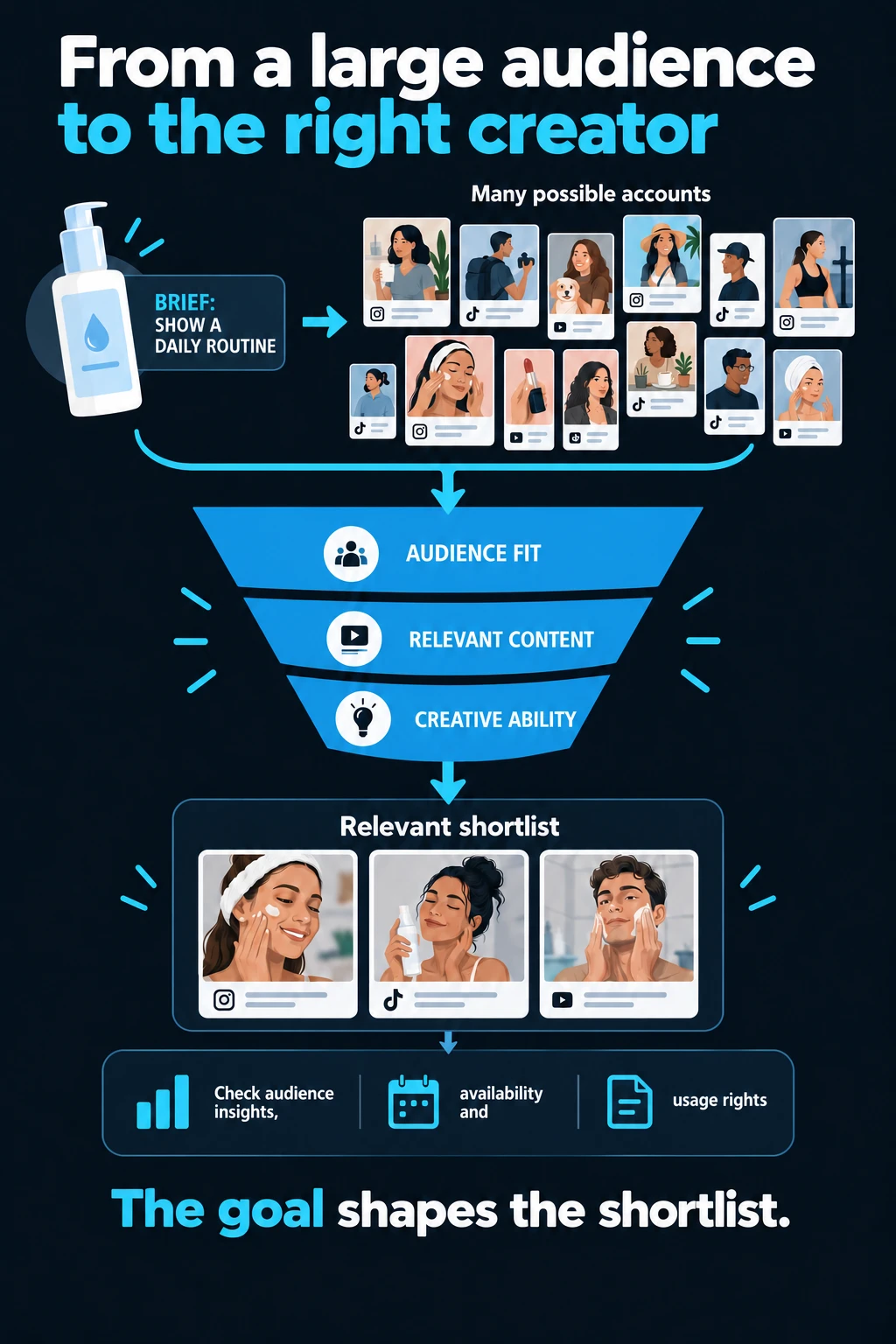
For example, a skincare brand launching a moisturiser might be tempted to partner with a lifestyle creator who has a large following. But if the goal is to show how the product fits into a daily routine, a smaller creator who regularly shares thoughtful skincare demonstrations may be a better fit.
Their audience, presentation style and ability to explain the product may matter more than the number at the top of their profile.
Before you start searching, write down:
- Your goal: Awareness, content, website traffic, sales, or a combination.
- Your audience: Who you want to reach, including location and interests.
- Your offer: The product, service or experience you want the creator to feature.
- Your preferred platforms: Where your audience spends time and where you intend to use the content.
- Your deliverables: What you need, such as a video, a series of stories or photography.
- Your budget and timeframe: What you can offer and when the work needs to happen.
A clear brief makes it much easier to assess whether a creator is suitable—and gives the creator enough information to decide whether the opportunity is right for them.
Look beyond follower count
Follower count can help you understand the potential scale of a partnership. It doesn’t tell you whether the people following an account are likely to be interested in your business.
When reviewing a creator, look at the whole picture.
Audience relevance
Does the creator appear to reach the people you want to speak to? If you’re an Australian business selling locally, a large international audience might offer less value than a smaller audience concentrated in your market.
Where possible, ask creators for audience insights rather than relying on assumptions based on their location or accent.
Content relevance
Look at more than one recent post. What does the creator regularly talk about? How do they introduce products or services? Would your brand make sense alongside their usual content?
A creator doesn’t need to have posted about your exact product before. But there should be a credible connection between what they already share and the story you want them to tell.
Engagement and conversation
Review comments as well as likes and views. Are people asking questions, sharing experiences or responding to what the creator says?
Engagement figures can be useful, but context matters. Results can vary between posts, platforms and content formats, so a single popular video shouldn’t be treated as a reliable forecast for your campaign.
Content quality and capability
If you want assets for your own marketing, assess whether the creator can deliver the format and quality you need. A compelling presenter may be a great choice for a product demonstration, while another creator may be better suited to photography or written reviews.
Ask for examples of comparable work and make the deliverables clear before agreeing to a partnership.
A long list of creators isn’t the same as a useful shortlist
One of the challenges with creator discovery is that it’s more complicated than matching a keyword to a profile.
A search for “skincare”, for example, might return creators who review products, beauty retailers, clinics, publishers and accounts that mention skincare only occasionally. Some may be excellent potential partners. Others may not create original content or be suitable for the campaign.
Even when a profile fits the broad category, it may not fit the brief. A creator who focuses on makeup tutorials might be less relevant to a campaign looking for detailed skincare demonstrations. Someone with a smaller, engaged audience interested in skincare routines could be a better match.
That’s why a useful shortlist needs to answer more than “Does this account mention the topic?”
- Is this a creator who produces original content?
- Is their content relevant to the campaign?
- Do they reach the right market?
- Can they create the type of content required?
- Is there enough evidence to justify including them on the shortlist?
These questions still benefit from human judgement. A discovery tool can make finding and organising candidates easier, but someone needs to consider the campaign, review the content and decide whether the partnership makes sense.
Consider the work that happens after discovery
Finding a promising creator is only the beginning.
A campaign can involve outreach, conversations about fit, negotiating terms, preparing a brief, coordinating timelines, reviewing content and making sure the final assets are delivered in a usable format.
If several creators are involved, that work can add up quickly.
It’s worth deciding who will manage each step before the campaign starts:
- Outreach: Who will contact creators and respond to questions?
- Agreement: What will each party provide, and when?
- Briefing: What must be included, and where does the creator have room to shape the content?
- Review: Is there an approval process, and how long will it take?
- Delivery: How will the content and performance information be shared?
- Follow-up: How will you assess the partnership and decide whether to work together again?
A good brief should give creators enough direction to understand the objective while leaving space for the style their audience knows them for. If every partnership is reduced to the same tightly scripted advertisement, you may lose the reason you wanted to work with a creator in the first place.
Our influencer marketing and campaign management services cover creator sourcing, outreach, briefing, coordination and reporting.
Agree on content usage before the campaign starts
A creator posting about your product and your business using that creator’s content in advertising are different arrangements.
Before work begins, discuss how the content can be used. For example:
- Can your business repost it on its own social channels?
- Can it be used on your website or in email marketing?
- Can it be used in paid advertising?
- For how long, and in which markets?
- Can the content be edited or adapted?
Put the agreed terms in writing. This gives both parties a clear understanding of what’s included and helps avoid problems when you want to reuse a strong piece of content.
Measure what the campaign was designed to achieve
There’s no single metric that tells you whether every influencer campaign worked. The right measures depend on the goal you set at the beginning.
- Reach a relevant audience: Reach, views and audience characteristics.
- Build interest: Engagement, comments, saves and questions.
- Drive website visits: Tracked visits and behaviour on the landing page.
- Generate sales or enquiries: Tracked conversions, enquiries and sales.
- Create reusable content: Number, quality and suitability of assets delivered.
- Build ongoing partnerships: Ease of collaboration and potential for future work.
Some outcomes are easier to attribute than others. A creator may introduce a brand to someone who returns later through another channel, for example. Use the data available, but be careful about treating any one number as the complete story.
The most valuable result may also extend beyond the initial post. A useful product demonstration, a set of strong photographs or a creator relationship that grows over time can support other marketing activity—provided your agreement allows for it.
A practical checklist for choosing creators
Before you add a creator to your shortlist, ask:
- Does their content make sense for our product, service and campaign?
- Is their audience likely to include the people we want to reach?
- Have we checked their recent content rather than relying on one post?
- Can they deliver the format and quality we need?
- Does their communication style fit our brand?
- Have we discussed budget, timing and deliverables?
- Have we agreed on content usage and any approval process?
- Do we know how we’ll assess the partnership?
You may not have every answer at the discovery stage. The checklist helps you identify what to verify before you commit.
Better partnerships start with a better brief
Influencer marketing works best when the creator, audience and business have a reason to be part of the same conversation.
That starts with understanding what you want to achieve, then looking for creators whose content and audience genuinely fit. From there, a clear brief, realistic expectations and a straightforward process give the partnership a much better foundation.
For more on briefing, content rights and measurement, read our practical guide to influencer marketing in Australia.
Need help planning an influencer campaign or finding creators who fit your brief? Talk to the Integral Media team about influencer marketing.