Generative Engine Optimisation: Why Most Australian Businesses Are Invisible to AI Search
Alex••7 min read
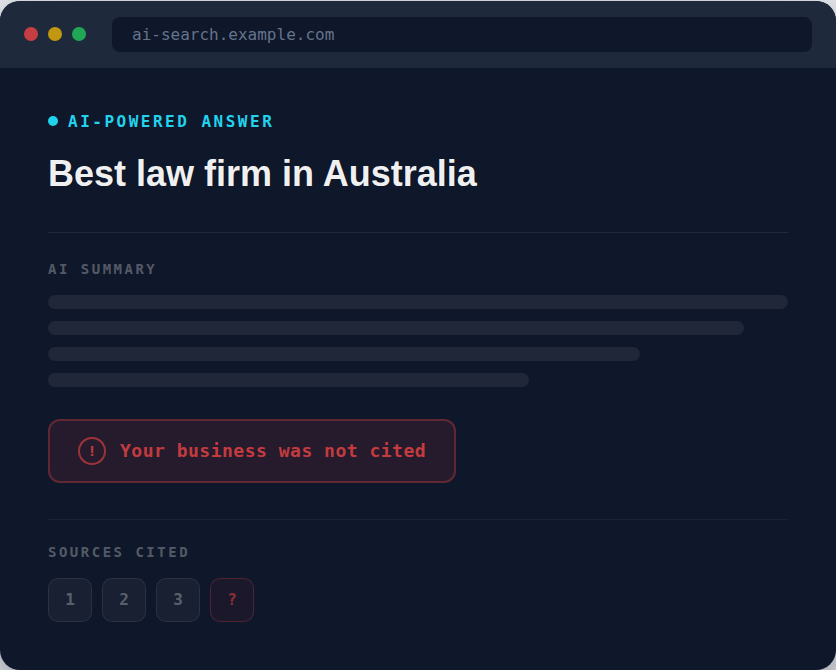
There is a quiet shift happening in how Australians find businesses, products, and services online. It is not dramatic. There is no single announcement that flipped the switch. But the effect is real: a growing portion of search behaviour has moved away from the traditional results page and into AI-generated answers.
Your prospective customers are typing questions into ChatGPT, scrolling through Google’s AI Overviews before they even see organic results, and getting summarised recommendations from Perplexity and Microsoft Copilot. These tools do not send users to a list of ten blue links. They synthesise an answer, and they cite sources.
The question for your business is simple: are you one of those sources?
For most Australian businesses right now, the answer is no. Not because they have bad products or services, but because their websites were built and optimised for a search paradigm that is no longer the whole picture. That is the problem Generative Engine Optimisation (GEO) is designed to solve.
GEO is the practice of structuring your website and content so that AI-powered search engines can understand, trust, and cite your business when answering relevant queries.
Traditional SEO is focused on ranking. You optimise for keywords, build backlinks, and aim to appear in positions one through three on a Google results page. GEO is focused on citation. You are not trying to rank in a list. You are trying to be the authoritative source that an AI system pulls from when constructing its answer.
These two goals are related but not identical. You can have strong traditional SEO and still be almost completely absent from AI-generated responses. The signals that AI engines use to evaluate trustworthiness, depth of knowledge, and topical authority go beyond what a standard keyword and backlink strategy addresses.
This is not an argument against SEO. Organic search traffic still matters and will continue to matter. The point is that AI-generated answers are now sitting above organic results in many queries, and they operate by different rules.
Google’s AI Overviews appear at the top of results pages for a significant and growing range of queries. Perplexity, which positions itself as an “answer engine,” has seen rapid growth among researchers, professionals, and younger demographics. Microsoft Copilot is embedded directly into Windows and the Microsoft 365 suite, meaning it is the first search experience for millions of users who never open a browser at all. ChatGPT now processes more queries per day than most traditional search engines outside of Google.
These platforms share a common behaviour: they read, interpret, and summarise content from around the web. They look for structured signals that confirm a source is credible. When those signals are missing, the content is skipped, regardless of how well it ranks on a traditional results page.
Thin content that reads like it was written to hit a keyword count, pages without schema markup, and businesses with no clear entity definition in AI knowledge graphs are simply invisible in this environment. The AI cannot confidently cite them, so it does not.
Understanding what AI engines are looking for is the foundation of any GEO strategy. There are four core areas worth understanding in depth.
Schema markup is structured data added to your website’s code that tells search engines, and AI systems, exactly what your content is about. It is written in a standardised vocabulary called Schema.org.
Without it, an AI reading your homepage sees a block of text. With it, the AI sees a clearly defined business entity with a name, location, service categories, reviews, and operational details. The difference in how your content is processed and surfaced is significant.
A medical practice without schema markup is just a page with some words about health. A medical practice with correctly implemented LocalBusiness, MedicalOrganization, and FAQPage schema is a verified, structured entity that an AI can confidently reference when someone asks “where can I find a bulk-billing GP in [suburb]?” Schema markup is not optional in a GEO context. It is the baseline.
E-E-A-T stands for Experience, Expertise, Authoritativeness, and Trustworthiness. Google introduced this framework as part of its quality rater guidelines, and it has become the lens through which AI systems evaluate whether a source is worth citing.
For Australian businesses, this means several practical things. Author credentials need to be visible and linked, not generic. Content needs to demonstrate genuine first-hand knowledge of a subject, not just surface-level coverage. External mentions, press coverage, and third-party validation all contribute to how authoritatively a business is perceived.
A legal firm that publishes content signed by a named senior partner, with that partner’s credentials, bar admission, and professional bio clearly visible, will consistently outperform a firm that publishes unsigned content on the same topics. The content might be equally accurate, but one sends clear trust signals to AI systems and the other does not.
Restructuring content for E-E-A-T is not about gaming the system. It is about making the expertise that already exists in your business legible to automated systems that are trying to determine who the real authorities are.
AI systems do not just read individual pages. They maintain internal representations of entities, meaning people, places, organisations, and concepts, and they draw on those representations when constructing answers.
If your business does not have a clear, consistent entity definition across the web, AI systems struggle to build a reliable picture of who you are and what you do. This means inconsistent business names across directories, a missing or sparse Google Business Profile, no Wikipedia or Wikidata presence for established brands, and a website that does not clearly state what the business does, where it operates, and who it serves.
Entity optimisation involves auditing and strengthening every signal that contributes to how AI systems understand your brand. This includes your Knowledge Panel data, structured citations, consistent NAP (name, address, phone) data across directories, and internal linking that reinforces your core topic authority.
AI systems are trained on and continue to draw from content that demonstrates depth. A 300-word service page does not give an AI much to work with when it is trying to construct a comprehensive answer to a nuanced question.
This does not mean padding articles with filler. It means investing in content that genuinely covers a topic with the kind of depth a subject matter expert would bring. Comprehensive guides, detailed case studies, FAQ sections that address real questions in plain language, and content that covers adjacent topics within your area of expertise all contribute to how an AI perceives the authority of your site on a given subject.
The businesses showing up in AI-generated answers tend to have made a consistent investment in content depth. They have covered their industry topics thoroughly over time, and AI systems have enough material to identify them as reliable sources.
When we conduct a GEO readiness audit for a client, we are looking at a specific set of factors that determine whether their site is currently optimised for AI citation or not.
This includes a structured data audit to identify missing or incorrectly implemented schema, an E-E-A-T review that examines how expertise signals are communicated across the site, a content depth analysis that identifies gaps where thin coverage is likely causing the site to be skipped by AI summarisers, and an entity audit that checks brand consistency across directories, knowledge graphs, and third-party sources.
The output is a prioritised action list, not a vague set of recommendations. The changes that will have the most immediate impact on AI visibility are addressed first.
The practical starting point is an honest assessment of where your business currently stands. Run your business name through ChatGPT, Perplexity, and Google AI Overviews. Ask questions that your ideal customers would ask. See whether your business appears. See what is cited.
If you are absent, or if competitors are being cited while you are not, that is a signal worth acting on now rather than later.
The businesses being cited by AI systems today are building a compounding advantage. Visibility in AI-generated answers drives trust, click-through, and brand recognition in a way that compounds over time. The businesses that establish strong AI search presence now will be significantly harder to displace in twelve to twenty-four months.
GEO is not a replacement for everything you have already invested in your digital presence. It is an extension of that investment, applied to the search environment that is actually emerging. Schema markup, AI-powered content strategy, entity optimisation, and authoritative content are not complex concepts. They are achievable for any business willing to apply them systematically.
The window to get ahead of this is open now. It will not stay open indefinitely.
If you want to know whether your business is currently visible to AI-powered search tools, Integral Media offers a free AI search readiness audit. We will review your schema implementation, E-E-A-T signals, entity presence, and content depth, and give you a clear picture of where you stand. Request your free audit here.

Written by
Integral Media’s Alex Morrison appeared on Channel 7’s The Morning Show to introduce Future Work AU, Australia’s first interactive AI jobs map. Here’s what the data shows.
The way businesses find freight forwarders and logistics partners has changed. If your company isn’t visible when potential clients are searching, you’re missing opportunities. Here’s how to navigate the digital landscape and grow your business. The freight and logistics industry […]
The construction technology space in Australia has grown rapidly over the past few years. From procurement to safety to quality assurance, there is no shortage of startups building tools to digitise the way projects are delivered. But despite all that […]